

🎯 Course Objectives (As per TU BBS Curriculum)
This course of Macroeconomics aims to enhance students’ understanding of macroeconomic theories and to develop the ability to apply these theories in business decision-making under different economic environments. The course focuses on analytical skills required to interpret economic conditions, policies, and macro-level fluctuations relevant to Nepal and the global economy.
📘 Download Notes📘 Course Description
This course enables students to understand macroeconomic theories and contemporary macroeconomic issues, particularly in the context of Nepal. It covers fundamental and modern macroeconomic concepts such as national income accounting, employment theories, Keynesian macroeconomics, inflation, business cycles, monetary and fiscal policies, and contemporary economic issues. The course combines theoretical explanation with numerical exercises to strengthen conceptual clarity and practical application.
📚 Official TU BBS 2nd Year Macroeconomics Syllabus (Detailed & Exam-Oriented)
The following unit-wise syllabus is strictly based on the Tribhuvan University (TU) BBS 3rd Year curriculum, rewritten in student-friendly and exam-focused language.
Macroeconomics is one of the most important and scoring subjects of BBS 3rd Year under Tribhuvan University (TU). This subject helps students understand national income, inflation, unemployment, economic growth, fiscal policy, monetary policy, and economic development.
These notes are prepared in a student‑friendly, exam‑oriented, and easy‑to‑understand language, strictly following the latest TU BBS syllabus. Ideal for short questions, long answers, and numerical understanding.
📘 Download Notes📚 Unit‑Wise BBS 2nd Year Macroeconomics Notes
🔹 Unit 1: Introduction to Macroeconomics
Meaning of Macroeconomics
Macroeconomics is the branch of economics that studies the behavior and performance of an economy as a whole. It deals with aggregate variables like national income, total employment, general price level, inflation, and economic growth.

Scope of Macroeconomics:
- Theory of national income
- Theory of employment
- Theory of inflation and deflation
- Economic growth and development
- Fiscal and monetary policy
Importance:
- Helps in policy formulation
- Useful for economic planning
- Solves unemployment and inflation problems
- Promotes economic stability
🔹 Unit 2: National Income Accounting
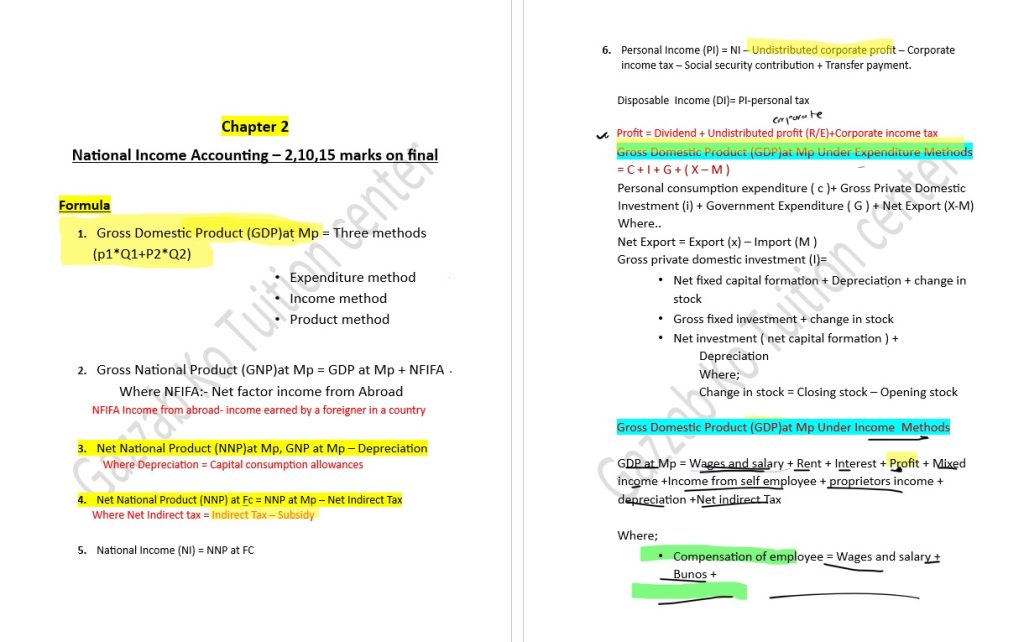
Concept of National Income
National income is the total monetary value of all final goods and services produced in an economy during a year.
Key Concepts:
- GDP (Gross Domestic Product)
- GNP (Gross National Product)
- NNP (Net National Product)
- Personal Income
- Disposable Income
Methods of Measuring National Income:
- Product (Value Added) Method
- Income Method
- Expenditure Method
Difficulties in Measurement:
- Non‑monetized sector
- Double counting
- Lack of data
- Illegal activities
🔹 Unit 3: Employment and Unemployment
Meaning of Employment
Employment refers to the engagement of labor force in productive activities.
Types of Unemployment:
- Frictional unemployment
- Structural unemployment
- Cyclical unemployment
- Seasonal unemployment
- Disguised unemployment (common in Nepal)
Measures to Reduce Unemployment:
- Skill‑based education
- Industrial development
- Promotion of self‑employment
- Foreign employment management
🔹 Unit 4: Inflation and Deflation
Inflation
A continuous rise in the general price level over time.
Types of Inflation:
- Demand‑pull inflation
- Cost‑push inflation
- Creeping inflation
- Hyperinflation
Effects of Inflation:
- Reduces purchasing power
- Affects fixed income earners
- Increases inequality
- Encourages speculation
Control Measures:
- Monetary policy
- Fiscal policy
- Price control
- Increase in production
🔹 Unit 5: Consumption, Saving and Investment
Consumption Function:
Shows the relationship between income and consumption.
Saving:
The part of income not spent on consumption.
Investment:
Expenditure on capital goods for future production.
Factors Affecting Investment:
- Rate of interest
- Business expectation
- Political stability
- Government policy
🔹 Unit 6: Fiscal Policy
Fiscal policy refers to government policy regarding taxation, public expenditure, and public debt.
Objectives:
- Economic stability
- Income redistribution
- Economic growth
- Employment generation
Instruments:
- Tax policy
- Government expenditure
- Public borrowing
🔹 Unit 7: Monetary Policy
Monetary policy is controlled by the central bank (Nepal Rastra Bank) to regulate money supply and credit.
Objectives:
- Control inflation
- Maintain price stability
- Promote economic growth
Tools:
- Bank rate
- Open market operation
- Cash reserve ratio (CRR)
- Repo and reverse repo
🔹 Unit 8: Economic Growth and Development
Economic Growth:
Increase in real national income over time.
Economic Development:
Qualitative improvement in living standard, education, health, and income distribution.
Problems of Developing Countries (Nepal):
- Poverty
- Unemployment
- Low capital formation
- Rapid population growth
🎯 Why These Notes Are Best for BBS Students?
✔ Strictly based on TU BBS 3rd Year syllabus
✔ Written in simple exam‑friendly language
✔ Perfect for short & long answer questions
✔ Useful for revision before final exams
✔ Prepared by NDGURU – Trusted Education Platform
📥 Free PDF Download
👉 Download Complete BBS 3rd Year Macroeconomics Notes (PDF)
❓ Frequently Asked Questions (FAQ)
Q1. Are these notes enough for TU exams?
Yes, these notes cover all important exam‑focused topics.
Q2. Is this based on the latest syllabus?
Yes, fully based on TU BBS updated syllabus.
Q3. Are numerical questions included?
Conceptual clarity is provided; numericals are explained where required.
BBS 2nd Year Macroeconomic model Question 2082
Happy Learning with NDGURU! 🌟